So I spent a while this morning going back and forth on today’s blog content. Who to feature? Marisa. No, Legba. No, it should be Marisa. Then I figured…what the hell…I’m going to do both because it’s my party and there are no rules.
Both Marisa and Legba are strong supporting characters within the Order of Crows. Every member of the Murder hail from different mythological backgrounds. It’s a world that’s all-inclusive, every religion and tons of different folklore. I was certainly ambitious when I started this story fifteen years ago. Yet I managed to make it work, with a nod of thanks to Neil Gaiman and his “American Gods” that made me realize way back when that I could basically do what I want when it comes to my stories. I’ll also say here that a lot of that mythology is loosely interpreted for creative purposes. At no point did I intend to stay rooted in fact, or traditional fiction, as the case may be for religions and folklore.
Legba, if you’re unfamiliar with the name, hails from the world of Voodoo. Marisa comes from ancient Mayan stories. With these two characters, I decided to make them both human and divinity. They’re demigods. Legba is the bridge to the loa, or Voodoo gods. He is the way for humans to link to their gods. Marisa’s domain is darker, and she is my other trigger warning from the story. Her domain is death by suicide, and the idea that those who take their own death by the reins have freedom in the afterlife.
In The Murder Meets at Dusk, Legba is antagonistic at best, especially when it comes to characters who have an affinity for darkness, mainly Marisa and Aleister. Marisa, on the other hand, is not antagonistic but she is prone to secrecy and seclusion. What a surprise that the two end up making an excellent team.
Please enjoy this excerpt from The Song of the Sparrow, Order of Crows Book Two:
He spins in wide circles, stomping to the drums. The blade gleams and flashes in the low light. Then he stops abruptly and, with a well-placed swipe, severs the head of the dove. Bright blood spurts from the rended body and pours down over Hattie’s hands.
It shouldn’t mean anything, the death of a small animal, but Marisa feels it in her core. Her breath catches and her gate slams open. Her power billows out into a set of ebony, smoky wings.
The sound of the drums dies. She looks around. The room looks the same but all the people are gone. Almost. Legba is here. Marisa steps toward him. His head jerks up and he whips around.
“How did you follow me?” he asks, his tone harder and closer to what he uses in the circle. His gaze skates downward and his eyes widen.
Her attention follows his and her reaction is the same. She’s wearing a long white dress that hugs her curves and has no sleeves. The dove coos in her hands, intact and calm.
“I don’t know,” she says.
“She comes naturally here.”
The voice is deep, heavily accented. Marisa and Legba look as one to its source. She hears Legba take a sharp breath and then he bows low. Marisa studies him for a moment then looks back to the other man. Maybe a man standing beside a second figure.
The first is tall, nearly seven feet. He wears a white, double-breasted suit made of linen that hugs close to his slender form, complete with a solid white tie and button-up shirt. Upon his head is a straw trilby hat, with a broad band of fabric the color of snow around its crown. Short, salt-and-pepper hair shows at the base of his neck. His skin is the shade of thick tar and his face shows soft hints of age lines in the residual light of the altar. His expression is a severe portrait of solemnity.
He says, “She is kindred by her own right,” and he smiles, his teeth like ivory.
“Thank you,” she says, gaze flitting to the other, shorter figure, also an old man, though his hat has a wide brim and he carries a straw bag on his shoulder. He’s not looking at them. His eyes are on the altar.
“I am Damballah. This is Loko,” says the tall one. Somewhere in Marisa’s memory the first name rings a bell. She doesn’t know much about Voodoo but she has heard that name. These aren’t men, she thinks, they’re gods. “Stand up, Legba.”
Legba straightens, all of his lines hard with tension. He seems nervous in a way that Marisa can feel rather than see. He holds his head high, though, and he’s still holding the machete.
Damballah casually slips his hands into the pockets of his pants and looks to Loko. The shorter, more wrinkled god steps forward. A stalk of rhubarb hangs from the corner of his mouth and it bounces slightly as he chews on it. Every line in his expression is hard. She watches shrewd, dark eyes again sweep the altar.
“Tonight,” he says without looking away from the array of items cluttered on the altar’s surface, “you do well, Legba.”
Damballah nods.
Breath rushes from Legba’s lungs, an overt and uncharacteristic show of relief that seems to create a wind that blows warm against them.
The dove in Marisa’s keep coos again and rustles its feathers, but it doesn’t try to escape her grasp. Her hair moves to taste the air. Then Loko pins Legba with a stern look that tinges on a glare, and the younger gathers his apprehension once again.
“Thank you,” Legba whispers.
Loko makes a long and impersonal hm as he approaches the altar. He’s much more interested in the booze that waits there, straight up, in two highball glasses. He spits the rhubarb onto the ground and picks one of the glasses, sniffs it, then drains it.
In the same vein as spotlighting Casper from my Order of Crows series, let’s talk about Johnny Mochni. Johnny is fairly quiet in The Murder Meets at Dusk. He’s a very supportive character. He really steps up in The Song of the Sparrow, and his development both took me off guard and delighted me. His potential totally slept through the first book and slammed open the door in the second book. He’s so important, in fact, that the title of the book comes from his arc within the story.
So, a little break down on Johnny if you haven’t read Dusk. There is a group in the story called the Elemental Courts. They’re humans, but they’re descended from the elemental guardians, who are very important to the story. Johnny is a member of the Earth Court, mostly a sort of field agent who’s most important role is being a member of the Order of Crows. Johnny’s line is descended from Hopi mythology but, their namesake aside, they are pacifists. Getting thrown into a war is a different sort of journey for him than his fellow Crows. I don’t want to give away too much, but I’ll say this. Turns out Johnny is a total badass.
Please enjoy this short excerpt from The Song of the Sparrow:
The soft, slightly husky voice that has been comforting Johnny goes quiet. The last note of the song seems to reverberate forever over the distant landscape. The hands that have been gently massaging the ache from his shoulders also still.
He can feel a deep thrum coming from the rock beneath him. It feels like his Murder. His own pain has abated for the moment. It comes to him in waves, a receding tide. He takes a long breath then opens his eyes.
The blood on his hands and arms has dried. The skull is rust colored, still gaping at him. The hot pains in his tired muscles have become a numbness in his hands, and the joints of his fingers are locked around the skull’s horns. The fire in the pit before him is low, casting strange and distorted shadows onto the rock face. The dancing darkness makes the skull look menacing.
“Thank you,” he whispers without taking his eyes from the flame.
If he looks at the skull he thinks of the agony that has ravaged him. He has no concept of how long he’s been fighting his own body, but he’s so exhausted that if he thinks about that pain, he may let go. The woman’s hands draw away from him, yet he can still feel her so close to his bared skin. He knows if she meant him harm she could have taken advantage of his weakness well before now. He doesn’t believe she does.
“I have come a very long way to find you, Johnny Mochni.”
That voice when speaking is … familiar? If he was in better mental shape he’s sure he could place it. He wants to turn toward her but he can’t move.
“Who are you?”
“You know me, Johnny.”
“I do.”
It was meant to be a question but it doesn’t come out that way. He’s sure she’s right. If he could just think clearly.
Her hands leave him and he hears a rustle of her movement. Without her close he’s suddenly cold. He catches movement in his periphery and his eyes slide sideways to watch her walk around him then kneel in front of him. Her face comes into focus over the steer skull.
“Kaya!” he says with a gasp.
She’s slender, her skin the same red-brown as his, her hair long and black. A royal like him and from his own Court, though ranked higher. Her almond eyes study his face and the shock that has to be apparent there.
“Did the Court send you?” he asks.
She slowly reaches forward. Her long fingers wrap around the skull’s face. She pulls the thing from his cramped hands. He resists at first, but when she takes its weight from him, the relief is disabling. His arms are left abandoned before him for several breaths that he uses only to flex his screaming hands. The bone of the skull begins to crumble to dust beneath her touch.
“They did not,” she says, brushing the dust from her hands.
Johnny’s arms begin to tremble and lower a fraction at a time. He grimaces, tries to breathe slowly. He’s so tired of pain.
“Then why are you here?” he asks, his tone quiet and strained.
“To see you through your trial,” she says. Her voice is like a warm wind on a summer afternoon. Her proximity does soothe him now that she mentions it.
“My trial.”
Again it came to his head as a question but came out of his mouth much more knowing. Finally he rests his arms on his knees. The tears that left him dry some time ago now rise against his eyelids.
As mentioned in my previous post, release day for The Song of the Sparrow, Order of Crows Book Two is just around the corner. I decided that today I’d like to talk about one of my favorite characters in the Order, Aleister aside. Today I want to talk about Casper Lekkas.
It’s true that characters sometimes surprise me as the writer. Casper was no exception. If you’ve read The Murder Meets at Dusk, you know Casper as the youngest member of the Order of Crows. He’s shy, awkward, always withdrawn, but you also learn in Dusk that Casper is a powerful mage. You don’t, perhaps, learn how powerful.
In Sparrow, Casper hits his stride. He starts to come out of his shell a bit and he gave me so much personality in the sequel. Casper is a chaos mage at his base, but I feel like the chaos part of his power doesn’t really come through until the sequel, which is understandable when the story in general starts with such a big cast. It was impossible for me to develop them all equally and still tell the story. So Casper’s spotlight doesn’t really happen until Sparrow. And, oh, does it shine.
I think this is a good time to mention that this is a dark fantasy story. There are elements of it that might sit uncomfortably for some. Casper also falls into that area due to the way he practices magic. There might be some triggers when it comes to him. Fair warning.
All of that being said, please allow me to introduce you to Casper in The Song of the Sparrow:
Santino eyes the others, more interested in their condition than he is the vampires’ house. Nichi is as still as a statue, staring forward as she no doubt sends the tendrils of her energy into the surrounding area. Miller fidgets restlessly, glancing around them, fingers absently counting the beads of the pearl and ruby rosary in his hand. Casper shudders violently, seemingly waiting on the head of a pin to act, his guns secured in their holsters.
Santino slowly twines his own rosary around his middle finger as his eyes run the length of Casper’s left arm, most of which is bared, save his close-fitting t-shirt and the strap of his double holster on his shoulders. Scars line much of the pale space, geometric and intricate patterns that turn his body into some living sigil. They are scars he shows no pains to hide. Santino has no idea what the sigils do but the savage nature of the practice makes him uneasy.
He thinks of the morning that began this epic day. He drove across town still half asleep to rescue Casper from the weeds of an abandoned gas station lot, as his body still tingled from the strange burst of magic that woke him from a deep sleep. He hadn’t yet directly made the connection of what made him get up and go, and it seemed easiest to leave Casper on his couch to recover from his exhaustion without questioning it.
It was only later, after several cups of coffee, after the magical buzz in his bones gave way to caffeine, that he realized it was the very sigil Casper had been charging that had risen to protect him in that dire moment. The question of why Casper’s magic had chosen Santino remains a more difficult one.
Santino notices a symbol, cut into the backs of Casper’s hands, carved since they parted ways that afternoon. The scabs have barely formed. A circle, nine points defined around its circumference in the same formation in which the Murder stands, and each point is connected inside like a nine-pointed star. The cardinal directions are notated, and there are neatly scribed words running around the outside of the circle. It must have taken a long time and a tiny blade to etch those little letters. It’s too dark for Santino to make out any of the words, which makes him ever more curious as to what they say.
The chaos mage’s hazel gaze turns on Santino like Casper can feel the priest watching him. The expression that meets Santino’s attention is surprisingly forward and the eye contact is electric. Such a far cry from the crunched grimace of pain earlier when the nightmares had stalked his heavy sleep. Gone is the frightened innocence with which Casper had regarded him when he woke to a protective touch, after Santino banished whatever had grabbed hold of his dream space.
Casper’s awkward shyness is nowhere to be seen. In its place is an obvious fascination and something else that sends a thrill shooting through Santino’s limbs, attraction. Santino doesn’t quite cover his surprise, nor does he deny the heady connection that lasts long enough to garner a curious look from Nichi. Casper looks away like nothing strange just happened. The cross in Santino’s hand feels obscene.
“Do we burn it down?” Casper asks, his tone quiet but firm.
Santino swallows thickly as Nichi studies Casper. She seems to be considering the option. Then she says, “As much as I’d like to, we need to focus on a way to ensure they’re also in the city.”
Silence settles at the end of her words and she looks back toward the house. Santino’s eyes are still on Casper, his thoughts still muddling over the overt connection the younger just made. Since he’s still watching he also sees the Lekkas’s jaw set.
“I can do it,” Casper says with an unsettling surety.
Santino sees Nichi turn back to Casper, eyes wide with obvious surprise. Santino mirrors the sentiment. This side of Casper has either been very well guarded or has emerged amidst the severity of their current situation. There’s a fierceness to him that he has never shown his fellow Crows.
“How?” Nichi asks.
Casper hesitates for a moment. He looks so young to Santino, the scars on his surface tragic. He takes a long breath then says, “Blood magic.”
The words sink like stones into Santino’s gut. An uncharacteristic anxiety follows them as the magnitude of those two words slowly reveals itself. Casper is right, it’s the one thing the vampires have no weapon against or resistance to. Santino instantly hates the idea.
Weighted silence brings Casper to face the rest of them, who are staring back.
“It’s practical for my path,” he says. He meets each of their eyes in turn, even Fr. Miller. “I can make them yearn for blood so strongly they’ll crawl into our streets like the ravenous dogs that they are.”
“Not just blood,” Fr. Miller interjects in his sharp accent that cuts through the familiarity among the other three. “If I am correct, your means of drawing them would enamor them to the blood that is offered by your pagan practices.”
Three sets of eyes critically study him. He adjusts his glasses and pins Casper with an expectant gaze, eyebrow cocking slightly.
“It’s true,” says Casper. Now he looks away from all of them to stare at the ground.
Santino’s attention volleys from Casper to Miller then to Nichi. They’re not really considering this, are they? Someone has to be a voice of reason here.
“Your blood?” he asks, not quite able to keep his expression from folding with disdain. “You want to use yourself as bait?”
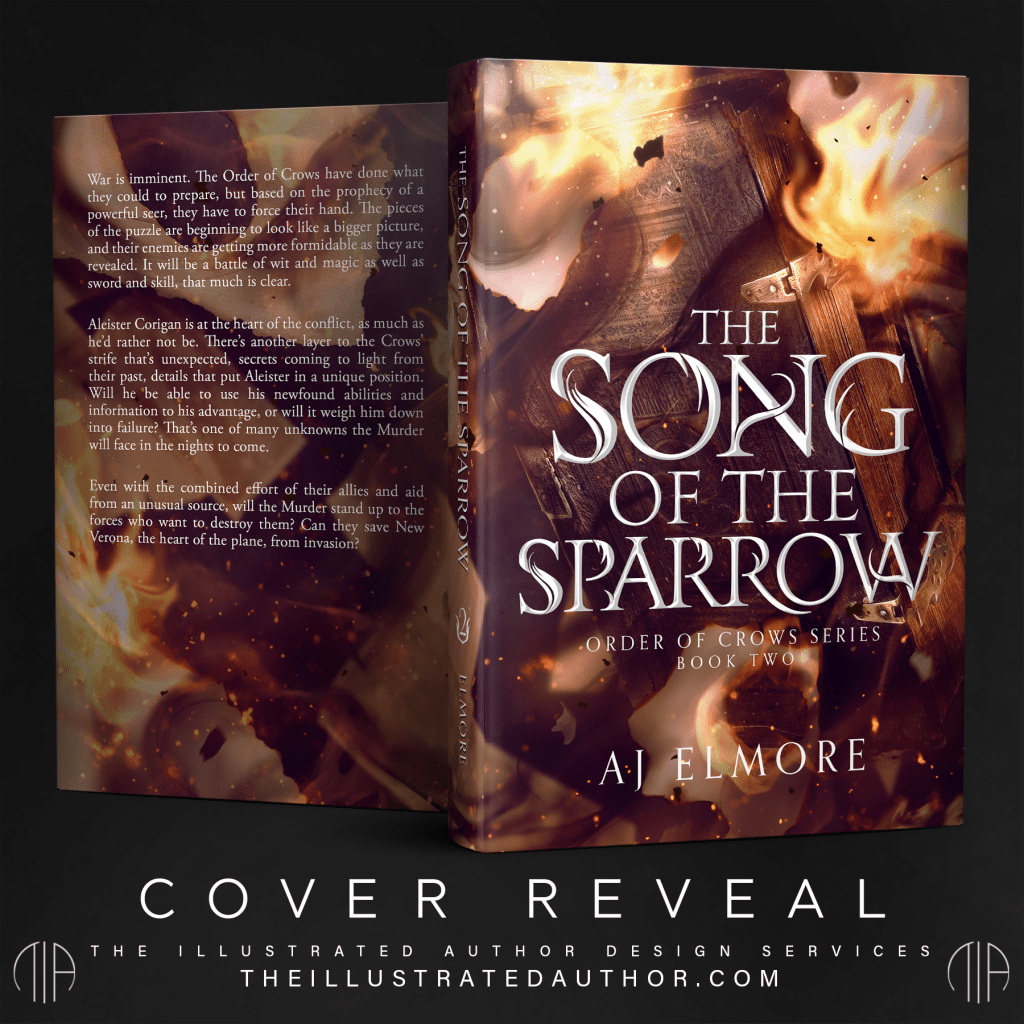
Excitement is amping up for my next release! This book is fourteen years in the making for me. To say that I’m proud to finally set it free to the wild is an understatement. Look for it to drop August 11, 2024. And until then check back here for an early look at the story and characters. This book is the second installment in my Order of Crows sequel, and if you haven’t read “The Murder Meets at Dusk” (Book One) you can find it on Amazon and KindleUnlimited. Also, look for a sweet deal on Dusk closer to release.
“The Song of the Sparrow”
War is imminent. The Order of Crows have done what they could to prepare, but based on the prophecy of a powerful seer, they have to force their hand. The pieces of the puzzle are beginning to look like a bigger picture, and their enemies are getting more formidable as they are revealed. It will be a battle of wit and magic, as well as sword and skill, that much is clear.
Aleister Corigan is at the heart of the conflict, as much as he’d rather not be. There’s another layer to the Crows’ strife that’s unexpected, secrets coming to light from their past, details that put Aleister in a unique position. Will he be able to use his newfound abilities and information to his advantage, or will it weigh him down into failure? That’s one of many unknowns the Murder will face in the nights to come.
Even with the combined effort of their allies and aid from an unusual source, will the Murder stand up to the forces who want to destroy them? Can they save New Verona, the heart of the plane, from invasion?
Happy Tuesday, y’all, even if it’s almost over here where I am. I’ve got some really exciting things on my horizon that will hopefully translate as also exciting for you. I’ve been quiet on here lately, which isn’t honestly that strange, but at least this time I’ve been quietly working.
My first bit of awesome news is I’m eying an August release for Order of Crows Book 2! Now, if you don’t know me or anything about my writing journey, know this release is a huge deal for me. The first book was originally published waaaay back in 2010 by Key Publications (now defunct). It was an amazing way to debut, but unfortunately the whole thing fell through before I ever managed to finish writing the sequel. Fast forward to 2022, I decided to publish the first book for myself. A ton of work went into revisions on said book, and it became clear later the same would have to happen for the sequel. It took me longer than expected, but those rewrites did painstakingly happen. The short version of the rest of the story is I’ve been working on all the behind-the-scenes stuff like formatting the physical and ebook versions, deciding what material to use for promotion, and all the little things that being indie entails. This sequel is fourteen years in the making and I’m extremely proud to finally release it into the wild. I don’t have an exact date yet, but check back often because things will start amping up around here when the time gets close.
The second part of my good news is we’re approaching the one-year anniversary of my release of The Nameless. I’m a firm believer that you should celebrate yourself and your achievements whether other folks join in or not. So I want to celebrate my fourth title release and we’re going to do it a little early. The actual release anniversary is August 1st, but since it’s also almost my birthday, The Nameless ebook will be free to download July 6th through July 8th. Get those megaphones out and shout about it! Warm up your like and share trigger fingers! I want as many people to know as possible.
Happy birthday to me! Happy anniversary to me! And happy free (July 6-8) book for you.
As you might know, I recently took some time with Author Katy J. Smith to ask her some questions about her debut novel. It was such an awesome thing to be able to do with a grand lady I’ve known for a lot of years. She decided to return the favor and put me on the other side of the table. She gave me some great questions that were a lot of fun to answer. What a look back it was for me, too.
Today, I’m excited to share with you some words from debut Author Katy J. Smith. She released her first novel this month, “Forgotten Voices: Excerpts from Valentina’s Journal,” and I had the pleasure of asking her a few questions about it. It’s a historical fiction piece that focuses on the West Virginia Mine Wars of 1912-1913. This book is a unique telling of the mine conflicts and I highly recommend checking it out.
The Interview:
Q: Start by talking a little about yourself and your writing journey. When did you start writing? What inspired you to do so?
A: Interesting question, simply because I just wrote a blog about a part of my writing journey. I love stories—whether I read them, whether I tell them, or whether I write them.
I sort of kept a diary, and I sort of wrote stories when I was younger. In public school, we had no formal writing instruction nor did we write outside of completing homework. My first true attempt at writing was in the introductory college Composition and Rhetoric class. I loved writing, although, at that time, I had issues with “what can I write?” I had things published in both the college’s literary magazine at that time as well as news stories in the Tech Collegian.
Then I became an elementary school teacher in 1983. At that time, teaching writing in public school, especially elementary school, was daring. Years before it was a county and state mandate, our teachers at Pratt Elementary decided to teach creative writing to our students, from Kindergarten through Grade 6. Our students did so well! (I wish I kept the vignettes of what my students wrote. WOW! They were great!) But, we teachers knew we needed training on how to teach writing. We took the seminars and staff development so we could teach effectively.
I’ve written or told stories since those days. It’s different as a writer because, while I want to tell a story, I want others to enjoy reading it. I have to look at it differently, and I have to employ tons of deep leveling thinking on what makes sense in the story.
I also took two writing courses at Marshall University after I retired. I’d take more, but I need on-line writing instruction due to the thing called ‘everyday living’. Most of those courses, if it’s what I need, fill quickly or aren’t offered on-line.
Someone (I think it was my grandsons) told me, words are just the same 26 letters put in different formations. I like making those different combinations.
Q:“Forgotten Voices: Excerpts from Valentina’s Journal” is historical fiction set in the 1912-1913 West Virginia mine wars, which is an interesting part of the state’s history that I feel is overlooked by folks who aren’t from there or haven’t lived there. Why did you choose that setting?
I’m a retired elementary schoolteacher who loved teaching. I am not good at the retired part of “retired elementary teacher.” On my first ‘official’ day of retirement, I was driving to sub in a 4th Grade classroom for a month. On my way to the school in the following days, I passed by a roadside marker that told the story of the Bull Moose Special, an armored train equipped with a Gatling gun, that shot up a small town of displaced miners who were living with their families in coarse canvas tents.
I knew the story from several sources: my grandfather, a coal miner, told me the story when I was young. I learned about it from my history profs at WV Institute of Technology. The children who live on Paint Creek attend the school where I taught had family stories to tell. Their grandparents, who were children in this time, told me some of their personal stories. Plus, I love Appalachian history, especially the coal history of WV, so I started digging into the region. As I read, I was horrified by the atrocities inflicted on these families, simply for wanting to provide a better life for their families.
So, basically, I couldn’t get the facts out of my head, and then a bunch of “What if…” questions formed in my head and wouldn’t leave.
Q:Your story is told mostly through the eyes of a thirteen-year-old girl, Valentina, whose family is caught in the midst of the mine strike. How did you decide on this unique take for your story? Was it difficult to put yourself in the mind of someone so young?
The grandparents who told me their stories were adolescents in the era. Their stories were heartrending. Their voices and eyes hardened as they talked about that night in their childhoods. Their expressions, as if they were lost in a nightmare, reflected the brutality of that time. Even my husband, who grew up near this area, told me about teachers and subs who told their personal stories. Each person who spoke of that time was conflicted by the events, but those events help to create their character, something that still is an underlying tone in their progeny, the people who still live in the area.
I wanted the story to be completely written in diary form. But I couldn’t develop my characters effectively through a diary format. (I’m not that talented, but I’m trying to develop it!) I taught mostly 5th and 6th graders, so I had an idea of how kids between the ages of 9 to 15 think. Plus, these kids, not a child but not an adult, usually have something that shapes who they become. I call it that defining moment. Valentina’s defining moment was the death of Cesco Estep, her neighbor. She realized it could have easily been the man she loved the most, her Pap.
I think of it as her Scarlett O’Hara moment when Scarlett swears, “With God as my witness, I…”. Valentina vows to find a way to help her family and her neighbors have a better life. She does through true journalistic integrity*, to write unbiased stories.
*I’m sending kudos to Dr. Ralph Turner of Marshall U’s Dept. of Journalism who taught me much about journalistic integrity way back then.
Q:To me, this novel does a great job of capturing the West Virginian spirit that can still be found in many small communities there. Did you draw from any personal experience to shape your characters and community?
Due to the mountainous terrain and isolation of many West Virginia communities, the people developed grit and self-reliance. This has been proven repeatedly from the earliest days of human settlement in WV, from the Mound Builders, and throughout its history. We West Virginians have a friendliness, but we can also survive. We love you, and we will help you. We will be a good friend and neighbor. But, don’t try to walk over our good-naturedness. We fight back.
Maybe that attitude is true for any small community, not just those in West Virginia. Although West Virginians are still a marginalized group, they have grit and are self-reliant. They help themselves and rarely whine about it. An example would be the 2014 flooding that devastated communities in different sections of the state. Another example is the people who live in a small community of Hico in Fayette County. We’re not hearing about the relief efforts for those who lost everything from the tornadoes in early April 2024. Those folks prayed about it, and then rolled up their sleeves to clean up the devastation so they can rebuild or find a viable alternative.
Fortunately, I’ve not lived through these types of experiences. But I am the daughter and granddaughter of coal miners. Even as a young girl growing up in rural Fayette County, I always feared someday Mom would receive word that Dad was hurt or killed in the mines. I remember the days of union activity and why men went on strike.
The only ‘coal camp’ I lived in was in Landisburg during my senior year in high school. The house was a nice cinderblock home, 3 bedrooms, and a full basement with a free-standing shower stall Daddy used to wash off the coal dust. The other six houses in neighborhood were as nice. The mine superintendent house looked lavish, but it wasn’t. It was an updated Craftsman with more bedrooms, a large front porch, and a wooden frame.
As for the spirit of West Virginia, I think about the ideas that shaped our American history. West Virginians have a strong work ethic, but they expect respect, fairness, and equity from their employers. They try to live by the tenets of their faith. They expect their children to ‘do better’ than they did because of having better educational opportunities. They are law-abiding for the most part, but they will not tolerate an injustice. They expect to be heard in these matters.
I find those same qualities in most rural areas in our country.
Q:This book is also quite informative about the events that took place in it. Was that information you were already knowledgeable about, or did you have to research everything?
It was a combination of both. I’ve always been fascinated by the coal mining history of our region. I knew some things about the 1912 – 1913 Coal Mine Wars. But I researched it as well, mostly to verify what I knew (or thought I knew) was true. Not only did I research about that era, I examined the beginning of the coal industry in West Virginia and how a region bounded by mountains was the leader in bituminous coal mining. Coal mining is the reason we had an era called the Industrial Revolution, which began in those regions of England. I researched its progression through time.
I also examined the impact of the 1912 -1913 Coal Mine Wars on other mining incidents. Within a year, the same Bull Moose Special gunned down another Tent City (with the striking miners living in the same tents supplied by the UMWA) in Ludlow, Colorado. The incident at Holly Grove, WV, set the standard on the importance of gaining basic needs, such as increase in pay, safety on the job, and in not having the script system of currency that can be used at only the one company store. One of the experts on coal mining and the labor union stated the events in Holly Grove taught the striking miners what they needed to do to ensure others listened to their voices.
During this era, from 1912 – 1913, the fight wasn’t only on Paint Creek but also on Cabin Creek. The two hollows are separated by mountains. If it were a flattened area, the distance would be around five to eight miles. The families on the two creeks helped each other, thus the incident of Valentina helping pull up the railroad tracks. *
Fortunately, we live in an era of using the internet. I could do most of my research from the internet resources available, especially from the WV Mine Wars Museum and the WV Encyclopedia, e- WV. But I also read books from the experts of the Coal Mine Wars. I now own an extensive library of their research! ☺
*This incident actually occurred in 1912, not 1913. I took creative freedom to make it one of Valentina’s ‘acts of defiance.’
Q:I feel there’s also a strong message about feminine independence in the story. Was that intentional, or did Valentina decide that for you?
It was a bit of both. I come from a long line of strong women. We enjoy being with our men, but we can fend for ourselves. My maternal grandmother, a quiet and tiny lady, married a coal miner. She could have easily been Valentina. They were the same age and had families who tried to shelter and protect them. Women in WV received the right to vote on March 10, 1920. My grandmother, a married woman around the age of 22 and mother of several children, registered to vote. She was proud of being a registered voter and kept her voters’ registration card in her purse. She voted in every election until her death in 1989, whether it was for the town, the county, the state or the nation. When the men tried to tell her how to vote, she would clench her jaw and then voted how she wanted. She listened to both sides and made her choices on what she determined to be the best choice. Thus, I chose to put some of those characteristics into the Valentina character.
Like many children, Valentina was sheltered by her family. Yet she yearned for independence and being treated as an equal, like many children do both then and today. She was at an age of rebellion, and she was wanting to be treated equally and equitably. Her mother recognized but yet hated that her child was growing up. Margaret Rose became the unofficial head of household when Walter disappeared. She and Walter’s mother Sylvia worked in tandem to keep their family safe. Valentina had strong models on how to survive in a bad situation.
Yes, Valentina started “talking” to me in the story. I had to rewrite chapters to show her point of view, and then often she would tell me more, so I had to rewrite again. But Valentina’s life changed in 1913, not only physically but emotionally. She recognized she wouldn’t be the girl who played in the creek and shared secrets with her girlfriends. She was growing up, often too fast, in a dangerous world. Fortunately, her family helped her grow and accepted the young woman she was becoming.
Q: Can we expect more titles from you in the historical fiction genre? Are there other genres you enjoy writing, as well?
I want to write more historical fiction! I love history and the ‘forgotten stories’ from the different eras. I’m mapping out another story and researching another topic that too is being forgotten. I would like to write a story about the European-based settlement in western Virginia.
My grandsons and I have discussed different topics over the years. I want to write non-fiction children’s books about our discussions. The boys are creative and forward-thinking. They ask good questions.
As a reader, I enjoy mysteries, perhaps my favorite genre. A mystery doesn’t have to be a whodunit, but it can be something that aggravates a person because there are unanswered questions. That’s the story I’m currently writing, but it has elements of romance in it as well.
I dabble in poetry, but I am not a poet. I’d love to be one though.
Q:Finally, you’re published through Rose Dog Books. There are a lot of ways to publish these days, and a ton of different resources for authors who choose not to go the fully traditional route. Tell us a bit about your publishing experience. What made you choose the way you did?
One of my writing goals is to use a traditional publisher! Wow! What a coup that would be! I researched they types of publishers available, and I knew what I wanted and, more importantly, didn’t want. I didn’t want to have to build a room to house 2,000 copies of my novel. I didn’t want to deal with certain aspects that a hybrid or traditional publisher can handle more efficiently.
Forgotten Voices: Excerpts from Valentina’s Journal is my debut novel, and Rose Dog Press (part of the Dorrance Publishing umbrella) is my first journey in publishing. Once again, I researched different publishers. I liked many of the subsets and skills of Rose Dog/Dorrance offered. I liked they were reasonably close to Appalachia and the coalfields, and, hopefully, would have a better understanding of what the beginning writers need. Overall, I’ve been pleased.
My advice on using any publisher includes:
Study what the publisher offers you, and see if it meets (most of) your needs. If not, move on to another publisher.
Follow, to the letter, the expectations of how to submit a query or your manuscript. Most publishers don’t want the entire manuscript. Read those points carefully, and then do what they request.
Set a budget that you can live with. (Don’t quit your day job!) Then, live within that budget. Also make sure you keep good records and receipts for your income taxes.
Know your contract, a legal document! Make multiple copies of it, keeping one as your legal document while you can mark up the others. Then make sure both you AND the publisher are meeting the points of the contract.
Work professionally and respectfully with your book team—from editing and revision, cover design, any book-related matters, and the publicity team.
Keep in touch with the different coordinators within the book team. If you haven’t heard something from them within a reasonable amount of time, email or call them. But don’t waste their time or yours. Be spot on with your questions and requests. Give them time to find or develop their answers, but also expect a timely response from them.
Above all else, have a publicity plan that you implement. Use social media. Have an author’s webpage. Write a newsletter or blog that you update regularly. Get your exercise by visiting local businesses and libraries to promote your book. Discover the ins and out of using Amazon and Good Reads. Go to the free zoom meetings on how to publicize your books.
When I have a second manuscript ready, I will go through the process again. I hope by then to have an agent to help me. I may or may not use Dorrance/Red Dog Press again. But, at this point in time, I’m not opposed to using them a second time.
A huge thanks to Katy for spending the time to answer my questions! And congratulations on her release!
Today I’ve decided to do a little something different for a post. Rather than posting writing samples, which is my favorite subject, I’m going to talk a little about what being a self-published author means to me. I can’t speak for anyone else, but I do have hopes my experience might be an inspiration for someone else out there who loves writing as much as I do.
It all starts with the books. Obviously, you can’t publish something that’s not written. Personally, I write my first drafts by hand. The process is certainly slower than typing directly, but I’ve found it helps me stay focused. Forcing my brain to form the words with my hand as I also string them together into something coherent keeps me locked into the moment. The whole experience is more organic. Then when I type that first draft I also do light editing. The first words in the notebooks are free of the editor brain. They convey the basic idea. The words that get transcribed are the first polishing of mechanics and descriptions.
I’m the type who always has several projects in the works. I highly recommend having multiple WIPs even if only one of them comes with the intention to publish. I’ve found this helps with stagnation and also provides time for characters to rest. Yes, I talk about my characters like real people. They’re basically my kids. Often times after putting them through high-stress situations, they need time and space to recover just as I do as the writer. So when certain characters stop talking, I move on to a different story for a while. This method means that at any given point, I have stories in different stages of development. For example, I recently finished massive rewrites on the sequel for “The Murder Meets at Dusk.” Those words are in the hands of a reader and will soon after go off to my wonderful editor. In the meantime, I’ve found my way back to the sequel for “The Nameless,” which has been on hold for some months at roughly 70% finished. Amongst those two major projects, I’ve been writing in a novella series that bounces around different characters’ points of view to create the bigger picture of the world and what’s happening in it.
What comes next? After a completed manuscript goes through the editing process, which entails several read throughs, the really fun part begins. (This is sarcasm.) Formatting has been one of the biggest learning processes for me. I wish I could say it has gone smoothly. Nothing draws the expletives out of me more than formatting. I haven’t reached the level of awesome chapter graphics or art inside the book, but I’ve learned to make my Apple Pages document look like an actual book and upload to Amazon KDP for print. Formatting the ebook is a bit of a different beast, some say easier. I think both formats have their own challenges, and both are rewarding. It’s an achievement I’m proud of, and in three years I’ve formatted four titles. There are, of course, other options for Indies to print by demand, but Amazon is the road I chose to take.
Other than editing, the only other thing I don’t do for myself is the cover. I have an amazing cover artist and friend, and it’s worth every penny to let her do her magic. There’s something to be said about knowing your limits, and mine is that. I think if I had any true advice for aspiring Indies, it’s that you absolutely need an editor, and your cover matters.
Then what? Title and cover reveals are a big part of raising hype for release. At this point, you call on all your resources to share your book on as many platforms as possible. This is the part where readers should be getting excited for your impending release. It’s typically not a long period, a few weeks maybe, but it’s a blitz of self-promotion. No one will ever be more excited than you are as the author when you reach the point when your words are released into the wild. It’s also scary, for me anyway, to know someone else will consume my words and worlds and characters. Likewise, no one else knows how much work goes into releasing a book.
Suddenly, it’s release day! It’s all excitement and guts twisted up into knots, fear, doubt, pride. It’s a lot. But it’s one of the greatest feelings I’ve ever had. Release day is the affirmation that all the work and effort paid off. That doesn’t mean sales will be amazing, but that’s a different story. Take your release day and celebrate yourself. You deserve it. Promotion never stops. It’s a job in itself. So take that one day to bask in your own glory. Trust me here.
Once your book is released, it’s out there. As I said, promotion is an ongoing process. It’s hard sometimes. Your friends will help. You might feel like you’re drowning in the never-ending social media grind, finding events to attend, ads and blogs and word of mouth. It’s a constant chase for ratings and reviews, sales, shares, and clicks. Isn’t it worth it, though? Again, no one will care as much as you do. It’s a choice and a commitment but, in the end, being Indie means you have control over your creation. You can choose your content, your aesthetics, all of it.
I’d love to hear from other Indies out there. What’s your process like? What successes have you found? What are you proud of? And to anyone still getting there, don’t quit. The world needs us.
I feel like I start every blog these days with, “I dropped the ball…” I gotta be honest, y’all, I don’t even know where the ball is. I can say I’m still here, taking a stab at indie life, if not a very good one. I don’t have any super exciting news right now, except maybe I’m considering running all my Kindle titles on a sale after Thanksgiving, with the hopes this past year hasn’t taken as much wind from your sails, my friends, as much as it has for me.
Alas, I haven’t posted anything here in a while, so it’s about damn time I do. I’ve decided to share the first chapter of the first novella in a series I have been working on with my creative partner. The whole project is probably still a long way off from seeing any sort of publication, but when it gets there it will be mixed media and something a little different. That being said, I’m still interested in getting some readers in on the project that is currently sitting at five novellas total from different points of view.
I have shared from this series here before, from the second installment. Today I’m going to post the very beginning. A short overview, the setting is a spin on post-apocalyptic, the fall of a society that would’ve been described as cyberpunk, and there are also strong fantasy elements to go with the tech. I would actually really love feedback on how the story starts, so feel free to leave me comments or messages!
The last thing I want to say before we start the part is … happy Halloween, spooky friends!
An excerpt from “Dirty Synth”, featuring Wen Daniri
Chapter 1
Most of us didn’t remember what life had been like before the demons came. There were some who did, the elves and the dwarves, but they kept those secrets in the space behind their borders. There were hints of the old world in the great cities that reached as far up as they did out, but they were crumbling ghosts.
Surely there were others who wondered about that world like I did. How did those people live before most of the planet became a wasteland? Was basic electricity so scarce? What had society been like before there was hell filtering through the blood of the masses?
The history passed down on the streets of Srong Sevina where I grew up was iffy. Some said the demons opened a rift for themselves, hellbent on death and destruction. Some said they came because our world had corrupted so much it wasn’t redeemable. No one knew for sure. They were too busy navigating crime-filled alleys and whole communities made of broken down train cars and subway systems.
It wasn’t until after I enlisted that I learned the Crown and the Cabinet weren’t even as old as the Fall. They were a result of it, a last-ditch effort to bring some order to a world that had fallen to chaos. I didn’t learn much later that it was also a point of contempt for some that the current Queen was herself of a hell-mixed descent.
The Queen’s military recruiters found me six years ago. The offer they had made was hard to beat. Relative stability, a steady stipend, a solid roof over me. It wouldn’t take much to beat slum life. That had been the plan anyway. Except when they put me through the initial screenings for basic training that plan changed.
Somewhere in those interviews I caught some important eyes. I met with increasingly ranked members of the military, eventually even the General and then the Queen. I never made it to basic but I was listed as a member of the 1st Division, the Queen’s Guard. Instead, I was assigned to tutors for reading and writing and, eventually, I started learning Elvish from the Queen’s personal language tutor. The General himself oversaw my martial training. I didn’t realize then how strange all of that was.
Over the years I met with the Queen regularly. It took me a while to realize she was grooming me for something specific, which came roughly two years ago when she gave me the title of Race Relations Adviser and strong armed me onto her Cabinet. That was when it occurred to me that she had made me a poster child for enlisting, the success story most folks would only ever dream of. I’d never regretted my decision once.
Despite all of that education, the history I wanted wasn’t taught. The closest I ever got was exposure to technology that the general population would never see, and contact with races who pretty openly despised humans. The tech had been rebuilt from that old world, mostly by the dwarves who stayed behind the walls of their industrial complex. They dealt grudgingly with the Crown because the royal machine was the only entity with enough resources for commerce. In turn the dwarves shared a small part of the electricity they produced with the Throne and the masses.
Hearing their concerns was my job. Though it was rare for them to make anything formal. It was hell when they did. They didn’t appreciate speaking to a human woman in her early twenties, by my best guess at my age, about official business, and their ambassador never missed an opportunity to insult me. At least they weren’t as bad as the elven ambassadors who simply refused to speak to me at all.
Still, my royal life was far above my younger years in the slums, scraping for food and scrapping with the competition for it. I didn’t have to worry about where my next meal would come from anymore. I had access to clean water and, for the most part, the struggle of the general population didn’t touch me.
I had spent most of the years after enlisting in the capital city, Caris, where the population was more heavily human than the demon-mixed streets of Srong Sevina, and the city’s infrastructure was kept in a little better repair. It had been, what, six months since the Queen had relocated me and other key players with her to Srong Sevina to try to get a handle on the heavily-demonically-influenced seat of violence and destitution. Srong was a hard place and it was getting worse.
The city was also home to a large cell of the Retribution, a human purist group who believed it was their right and mission to exterminate any and all hell blood from what was left of the planet. They took matters far past regular demon hunters, who tended to focus on pure-blooded demons. The Retribution would target anyone of mixed descent, too. As far as I was concerned, they were little more than terrorists. However, they had managed quite a seat of power before they began blipping on the royal radar and now they were a holy pain in the Throne’s ass.
Those were just the biggest items at the top of a list of problems that rolled on seemingly forever. So far, our presence in Srong hadn’t made much difference at a street level. Most folks in the city had little use for anything royal, they were much more concerned with survival and our resources were already stretched too thin to do much for them.
I checked myself in the mirror. My long red hair was down against my shoulders even though I knew by midday the city would be so hot I’d regret it. I was wearing a short white jacket-vest with a high collar and actual metal buckles over a black midriff shirt and a knee-length skirt. Fashion was something not always readily available to everyone, especially something like the chunky white boots that matched. I had just gotten that outfit.
The Queen, of course, had her own tailors who also made my clothes. The general population often had to settle for more general trends they could find at the market. Often times they also made their own modifications to those trends.
I nodded satisfactorily at my reflection. I wouldn’t go to my scheduled meeting looking like I had also just come from the commoner market. Cipher would be hard enough on me as it was.
I picked up my handheld and headed out the door of my apartment. The tablets were one of those bits of technology that were far from common. They had lit screens and keyboards, connected to a wireless network that only worked inside the Paaj Military Compound that had been our makeshift home for the past six months. Mine beeped to remind me of the meeting.
I silenced the alarm with a sigh. I sped up my steps. I’d never hear the end of it if I was late, and it wasn’t that uncommon for me to be late. I wouldn’t give the dwarf an easy jab. I might even be a little early.
The long-awaited day has finally come! The Nameless is now available on Amazon (paperback and Kindle)! I am so excited to share my boys with the world. This story is a unique blend of my noir-influenced style, Fae slow-burn head games, and my adoration of the live music scene. I hope someone out there loves it as much as I do.
Click here to follow the link!
Excerpt:
It’s about three in the morning. Johnny is asleep on the back seat of the van, which is parked at the edge of a Walmart parking lot a little way out of town, beneath the cover of a few overhanging trees. Chance is sitting in the grass in front of the van, leaning back against its nose, staring off. There’s a pile of spent cigarettes beside him and when I sit next to him, he ignores me.
I’m still riding a decent buzz from the bar, but I can tell he’s not in the mood for any theatrical shit or troublemaking. He gets like this occasionally. He’ll be surly for a few days, dark and damn near unbearable, but it will pass. It always does. One thing I can pretty much guess is that meeting a woman with a little depth isn’t helping the situation. I get it. Really, I do. That brand of loneliness isn’t easy to come to terms with and it’s definitely not new. Still, after so long, you’d think he’d have learned to cope with it a little better.
I snatch his pack of smokes from beside him and shake one out. I use his lighter to spark it. Usually, he says something shitty when I steal his cigarettes but, right now, he keeps ignoring me. I blow a thin stream of smoke into the early morning and say, “Maybe you should try to get some sleep.”
“I hate this place,” he answers. It’s more of a response than I was expecting and not at all what I thought he would say.
“We haven’t even been here a full day, how can you hate it?”
He smokes quietly for a while then sighs. He says, “I can feel it siphoning off energy, like it wants to keep us forever. It doesn’t feel right.”
Ah. His bad mood is starting to make a little more sense now. Over the course of our long years, he has developed a sensitivity to – for lack of a better term – magic. There’s a ninety-nine percent chance that if someone is a practicing witch, he’ll know. If there’s a strong concentration of a viral religion, he’ll feel it. I’ve seen him spook over a street oracle so hard he started shaking and bolted when she touched his arm.
Not me. I couldn’t pick up on a spell if it kicked me in the balls. Nah, instead I’m the one who feels our power activate. I feel us trigger fortune like a line of dominoes. If there’s someone whose life we can change for the better, I know it. I can tell when our presence starts tugging on the lines of someone’s fate. He would have no idea if I didn’t tell him, which reminds me …
“Someone in that bar needed us to be there,” I say. It occurs to me after the words are out that they may not be something he wants to hear right now, or ever again.
I can practically feel him gather his tension along his lanky lines, into his muscles and his aura. He crushes out his cigarette and swears under his breath in Irish – a language we learned as kids from immigrant parents, a language we rarely speak anymore. To hear it actually raises goose bumps along my arms.
“Don’t fuckin’ say it,” he says and I can hear traces of an accent we both lost decades ago. “Don’t tell me it was her.”
It doesn’t work that way. He knows I can’t really pinpoint the source, not spot on anyway, but I’ve gotten pretty good at making educated guesses. I don’t say it, though, which is a pretty good admittance that he’s right. He immediately lights another smoke.
I fold my legs up so that I’m sitting cross-legged and take a drag of my own. I could see it on his face at the bar that something was getting to him. Now I understand that it’s a grand mixture of several things that all stem from our unique roles in this fucked-up world.
He rests his head against the van’s bumper, staring forward, and sighs. He softly says, “I’m tired. Of all of this.”
“What choice do we have?” I say with a shrug. This isn’t the first time we’ve had this conversation.
“There has to be a way to end it,” he answers in a growl.
I haven’t thought about that night in a long time. I can usually distract myself with an array of mind-altering substances. Tonight all I have is a fading blood-alcohol level and my brother, being absolutely wretched.
“The problem here, dear brother,” I say, dropping into full Irish-accented English, “is that we pissed off the Summer Queen.”
Now I’m the one staring off at the vague darkness where the river winds through the area. I can still see the movement of him turning his head to look at me. Having a twin for a hundred years is … exhausting. I don’t need to see him. I can feel the giant hole I just carved in him by speaking the way our parents taught us to when we weren’t at home. It happens so little that the words feel strange to me.
He looks away before he says, “Maybe we can find her.”